The growing use of crypto cards on the Visa network signals a renewed and accelerating consumer interest in leveraging cryptocurrencies and stablecoins for everyday retail payments. This trend not only reflects a rebound in digital asset adoption but also highlights a shift toward greater global diversity in usage patterns, as consumers across multiple regions increasingly integrate these instruments into mainstream payment behaviors.
Visa facilitates crypto card programs that bridge digital assets and traditional payment systems. These programs allow consumers to spend cryptocurrencies or stablecoins at any merchant that accepts Visa. The conversion from digital assets to local fiat currency occurs instantly at the point of sale. Merchants experience no disruption, as they receive standard payments through Visa’s existing settlement process. This approach leverages Visa’s infrastructure to integrate digital assets into everyday commerce without requiring changes on the merchant side.
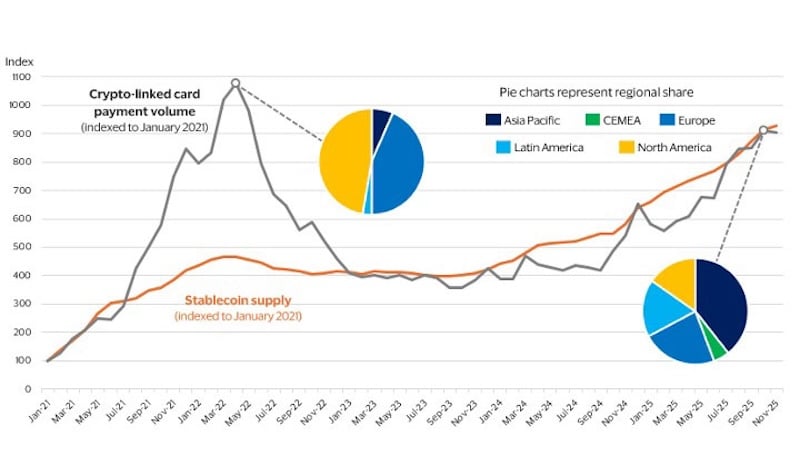
Figure 1 below tracks crypto card payment volume (PV) on the Visa network indexed to January 2021 and revealing a sharp increase—about elevenfold—by April 2022. This surge coincided with two developments: Bitcoin’s price rose about 342 percent year-over-year, hitting a record high at the time of $67,550 in November 2021, according to CoinMarketCap. Meanwhile, stablecoin supply expanded fivefold, providing more liquidity for payments and card funding.
At its peak, usage was concentrated in Europe and North America, consistent with early issuance patterns. The collapse of Terra Luna in May 2022 triggered a retrenchment and a prolonged “crypto winter,” during which PV flattened through 2023. From 2024 onward, PV resumed steady growth, broadly tracking stablecoin issuance. By the end of 2025, volumes are nearing prior highs, and regional participation is far more diverse, with Asia Pacific leading and other regions more evenly represented.
Figure 1: Crypto card payment volume