
Key findings
- Companies and economies with a more widespread digital payment infrastructure see higher output per worker.
- A 10 percent rise in digital payment capital per employee yields roughly a 0.5 percent rise in productivity.
- Investing in payment technology is as economically justified as investing in other digital infrastructures.
Why productivity matters
Almost 70 years ago, Robert Solow published Technical Change and the Aggregate Production Function, a landmark study that redefined how we understand long-term economic growth.¹ His analysis showed that growth was not just driven by accumulation of capital and labor, but also by technological progress. Solow’s study also became the foundation for measuring and analyzing sources of productivity growth.
What is productivity? Productivity measures how efficiently inputs are converted into output. An input can include materials, machinery, electricity, business services, and the time people spend working. Output is the amount of goods or services sold. Increases in productivity allow companies to produce more output for any given level of input. Productivity improvements can also lead to higher wages for workers, investment into the business to improve their product or service, increased profits, and even lower prices for consumers.²
Improvements in productivity can also translate to improvements in living standards. Even a small productivity boost can have meaningful implications over time. This is why Nobel laureate Paul Krugman, famously observed that “productivity isn’t everything, but in the long run it is almost everything.”³
How digital payments improve productivity
There is a rich literature studying how certain inputs impact output.⁴ Although multiple factors can affect productivity, one important factor introduced by Solow’s foundational work is technology. In a recent study, Digital payments, output, and productivity: an empirical exploration, authors Cormier et al. make an important contribution to this literature and explore how digital-payment technology can improve labor productivity both in the retail industry and in the overall economy.⁵
What does the study measure?
There have been major surges during the 20th and 21st century in information technology adoption. To account for this, the authors took a novel approach to isolate the impacts of digital payment technologies, such as electronic funds transfer at point-of-sale terminals, that have become increasingly widespread and are believed to streamline commerce.⁶ This study — covering 28 European countries over 26 years (1995-2020) — examines whether streamlining commerce with digital payments materially impacts economic output and labor productivity. Since there have been major surges during the 20th and 21st century in information technology adoption, the authors took a novel approach to isolate the impacts of digital payments technology. Specifically, the authors create a model of the economy with three distinct categories of capital investment,⁷ namely: IT capital; non-IT capital; and digital payment capital. For purposes of this study, the authors use electronic funds transfer at point-of-sale terminals as the indicator of payment capital. By analyzing a rich dataset (i.e., EU KLEMS for economic output and inputs, combined with European Central Bank data on payment terminals), and applying statistical models, the study isolates the effect of digital payments on productivity. Through this rigorous approach, the authors found that greater use of digital payments leads to modest improvements in productivity for merchants, and for the economy overall.
What are the implications?
Digital transactions can make sales processes faster and more efficient. For example, card payments and mobile payments often process quicker than cash transactions, reducing checkout times. They also enable new retail practices like self-checkout lanes and save labor by eliminating manual cash handling at day’s end. Beyond retail, sectors like restaurants, hospitality, and transportation also benefit through faster service. All these improvements suggest that, when businesses invest in digital payment technology, employees can serve more customers and handle more transactions in the same amount of time — or, alternatively, businesses can serve the same number of customers and handle the same number of transactions with fewer workers or fewer hours worked. In either case, output per worker (or output per hour worked) rises. As an example, digital payment technology has enabled McDonald’s to optimize its staff allocation, which has improved productivity and allowed the restaurant chain to provide better service to its customers.⁸
The study quantified this effect by incorporating the number and investment values of electronic funds transfer at point-of-sale terminals as an input in the national production function. The study controlled for traditional inputs (labor hours, non-IT capital, other IT capital) and external factors like broadband internet penetration, trade openness, and regulatory quality.⁹ By using fixed-effects panel models, the analysis accounted for inherent differences between countries and years.¹⁰ The researchers also employed instrumental variable techniques to address potential reverse causality (i.e., the possibility that richer economies simply invest more in payment terminals).¹¹ This rigorous approach lends credibility to a causal interpretation: increased adoption of digital payments leads to higher labor productivity, rather than just coinciding with it.
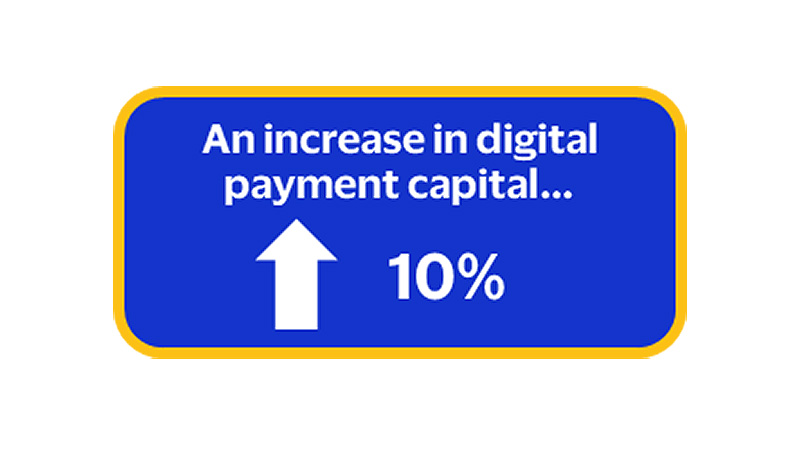
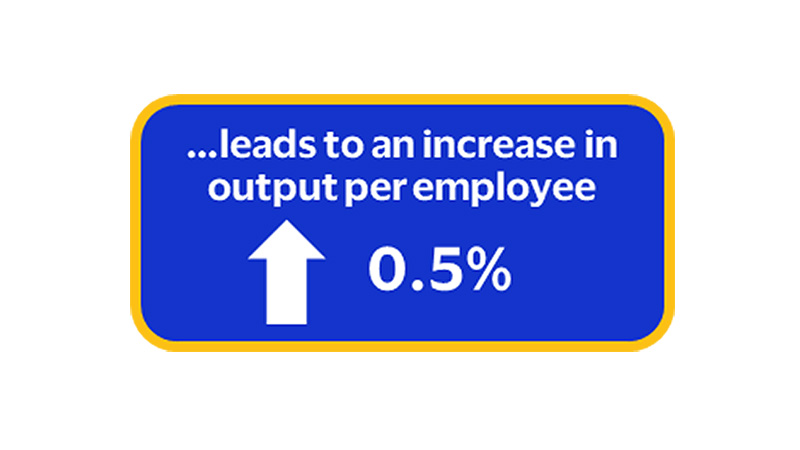
Across a variety of model specifications, the effect of digital payment adoption on productivity was consistently positive and statistically significant. In the primary models, a 10 percent increase in digital-payment capital per employee was associated with approximately a 0.5 percent increase in output per employee. In other words, if a country (or business) doubles the number of card-payment terminals per worker over time, it could expect about a 5 percent increase in average labor productivity, all else being equal.
Conclusion
This research provides clear empirical evidence that investing in digital payment technology results in higher productivity. For businesses, the message is that facilitating digital transactions can incrementally improve operations. Over a large workforce, it’s plausible that even a half-percent uptick in output per employee can translate into sizeable revenue gains, improved customer throughput, and labor cost savings. Moreover, these improvements help organizations serve customers faster and more securely.
Robert Solow’s renowned work reminds us that productivity growth is the key driver of long-run prosperity and rising living standards. It seems reasonable that even modest productivity improvements from payment digitization can accumulate at the macro level, potentially leading to higher GDP growth over the long run. As such, policymakers should consider different ways in which supporting merchants and consumers with increased digital payment options can yield economy-wide benefits. Additionally, policymakers could also explore how gains from digital payments are potentially amplified by other technological factors (i.e., reliable internet access) and determine how global market access can further drive technological growth.
As businesses and policymakers continue to navigate the digital transformation of commerce, this research offers evidence that shifting to digital payments is a sound investment in productivity. The key is to recognize that technological improvements at scale strengthen the foundation for growth. Both businesses and policymakers can draw on these insights to champion initiatives that expand digital payment usage, unlocking incremental gains that bolster prosperity.
Footnotes:
- Solow, R. (1957, December). Technical Change and the Aggregate Production Function. Review of Economics and Statistics 39(8).
- U.S. Bureau of Labor Statistics, “Why is Productivity Important?”
- Krugman, P. (1990). The Age of Diminished Expectations. MIT Press.
- Literature reviews include but are not limited to Kretschmer (2012), Van Ark, O’Mahony, and Timmer (2008), Triplett and Bosworth (2004), Ratchford (2016), Syverson (2011), and Birigozzi, De Silva, and Luitel (2025)
- Matthew Cormier, Gabriela Diniz, Daniel Garcia-Swartz, Oliver Latham, and Chara Tzanetaki, “Digital payments, output, and productivity: an empirical exploration,” Social Sciences Research Network (SSRN), 2025
- For this paper, electronic funds transfer at point-of-sale (EFTPOS) does not represent eftpos Payments Australia Ltd or Eftpos NZ. Instead, it refers to electronic funds transfer at point-of-sale terminals as defined by the European Central Bank.
- In simple terms, a production function describes how total output of an economy is generated from its inputs (i.e. physical capital and labor, combined with a factor for technology).
- EZ-Chow. (2024, February 9). How McDonald’s Self-service Kiosks Changes the Customer Experience Game.
- The quality of the regulatory environment for each country is measured using the Worldwide Governance Indicators (WGI).
- Panel data observes the same entity repeatedly over time (i.e., income for the same group of people). A fixed-effects model controls for time-invariant characteristics of each entity (i.e., person’s innate ability) in the data set that could influence measured outcomes.
- In observational data, finding a correlation between two variables doesn’t mean one causes the other. Instrumental variable techniques use a third factor (an “instrument”) that influences the supposed cause but has no direct effect on the outcome.