
We are in the midst of a transition. Changes in technology, policy, and finance are shaping the future in real time. These changes underpinned many of the discussions that took place in Washington, D.C. earlier this month for the Spring Meetings of the International Monetary Fund (IMF) and World Bank Group.
As world economic leaders arrived in Washington, the questions hanging over the proceedings felt heavier than usual. Geopolitical tensions have escalated amid expanding conflict. Trade and investment are facing new and compounding frictions. Fragmentation in the global economic order is deepening. And alongside these developments, leaders continue to grapple with rapidly advancing technologies like artificial intelligence and stablecoins, which promise enormous gains while raising important considerations. Despite these concerns, I left Washington with good reason to believe we can meet this moment. Here’s why.
First, the institutions guiding the global economy are led by people who understand technology’s role in boosting resilience.
There is a meaningful shift underway in global economic leadership. Top executives at key international financial institutions like the World Bank, Bank for International Settlements, and Financial Stability Board include former CEOs and central bankers who understand that technology is not peripheral to economic policy; it is central to resilience, growth, and inclusion.
This understanding comes in part from firsthand experience addressing previous global crises. The COVID-19 pandemic forced a generation of policymakers, business leaders, and multilateral officials to make high-stakes decisions under conditions of radical uncertainty. It also clarified that effective crisis response cannot be ideological or backward-looking. When shocks arrive from many directions at once, leaders need to be pragmatic about how public policy, private capital, and innovation interact. That pragmatism was evident during the Spring Meetings.
Second, the private sector is leaning in, not pulling back.
Another encouraging sign at this year’s meetings was the active and constructive involvement of private-sector leaders. Despite recurring rhetoric about the unraveling of global cooperation, the business community continues to invest time and attention in the practical question of how to support resilience and growth.
We saw an important example of this during South Africa’s 2024-2025 G20 Presidency, when a group of global business leaders—including representatives from Visa, Standard Chartered, and JPMorgan Chase—came together through the B20 Finance & Infrastructure Task Force.¹ This newly formed task force produced recommendations for expanding investable infrastructure projects in emerging markets and developing economies, helping address longstanding financing gaps.
That work continued during this year’s Spring Meetings, where the Visa Economic Empowerment Institute (VEEI) hosted a salon breakfast titled, “Finance and Infrastructure for Development: The Private Sector Opportunity.” During the salon, members of the VEEI Advisory Council were joined by business leaders, central bankers, and development professionals to discuss how to carry the momentum started in South Africa to this year’s U.S. G20 Presidency and beyond.
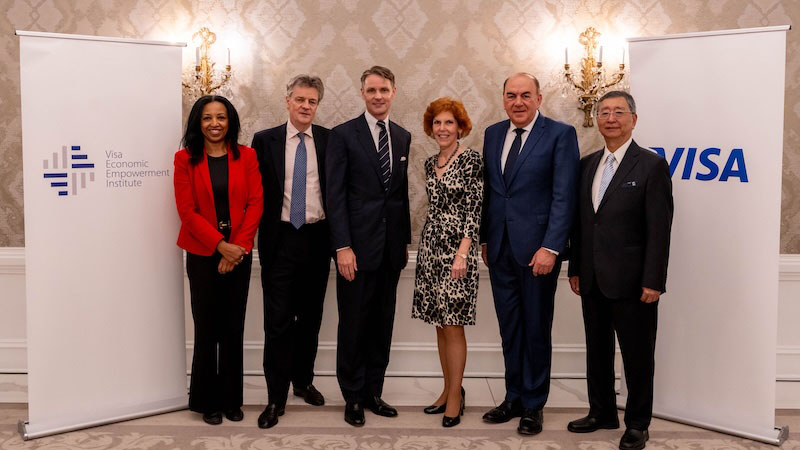
These discussions were defined by the recognition that challenges at this scale require more than government action alone. Across wide-ranging issues, implementation is often driven by the private sector at one point or another.
Third, beneath the geopolitical noise, there is real willingness to cooperate where it counts.
It would be overstating things to say that countries and leaders are fully aligned. They are not. The geopolitical environment is plainly fractured, and no serious observer should minimize the stakes. But one of the more important takeaways from the week was that—below the headlines and formal positioning—many who do the day-to-day work remain deeply committed to cooperation. While countries may differ in their strategic priorities, the professionals tasked with responding to these pressures share a practical commitment to preserving stability, supporting growth, and protecting vulnerable communities.
The importance of this commitment was articulated perfectly by Dr. Axel Weber, former president of the Deutsche Bundesbank and chair of the VEEI Advisory Council. During a live episode of VEEI’s new podcast series, Policy Sandbox, recorded on the sidelines of the Spring Meetings, Dr. Weber offered an important reminder: “If everyone moves their levers with the view of producing a global good, we’re all better off.”
That kind of cooperation rarely announces itself in sweeping declarations. More often, it shows up in the steady work of identifying shared interests and finding practical paths forward. It may not always make headlines, but it makes a real difference.
A closing note
As I left Washington, I was reminded why institutions like the IMF and World Bank were founded in the first place. Born out of the wreckage of the Second World War, they were built on the premise that the prosperity of the most vulnerable is inseparable from the prosperity of all. That mission feels especially relevant now. The compounding threats we face will fall hardest on the communities these institutions were designed to serve. Meeting that responsibility will require battle-tested leadership, sustained private-sector commitment, and the kind of ground-level cooperation that is easy to overlook from a distance but essential in practice.
The optimism I left with is not a denial of the difficulty ahead. It is a recognition that the tools, talent, and institutional memory required to meet this moment already exist. We need only find the will to deploy them.
- B20 South Africa 2025. (n.d.). Finance and Infrastructure Task Force.