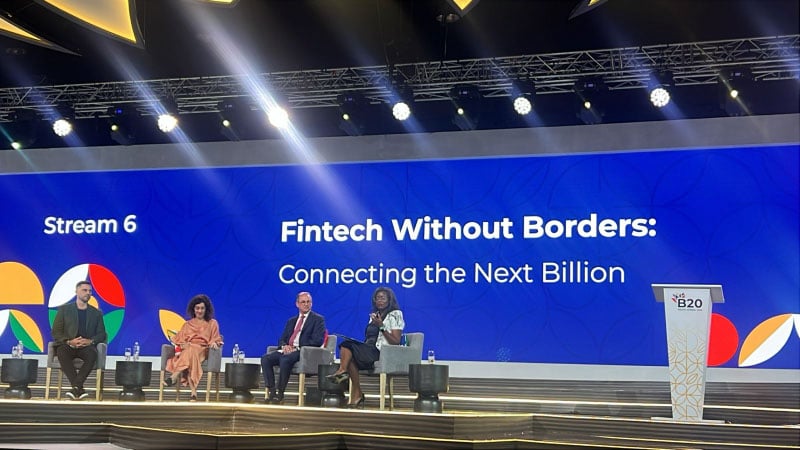
As the dialogue from this year’s Business 20 (B20) Summit continues, financial inclusion and digital transformation are no longer separate goals, but deeply interconnected pillars of global economic progress. The central challenge now is to move from principle to practice and identify where technology can most effectively scale inclusion and drive growth.
The transformation is already taking shape across three critical frontiers for consumers, businesses, and the financial institutions that serve them.
1. Transforming Remittances into a Driver of Global Equity
A crucial starting point is the experience of individual consumers. International remittances remain a lifeline for many emerging economies. Globally, cross-border remittances surpassed $905 billion in 2024, 80% of which is a lifeline to low- and middle-income countries¹. Yet there are still many frictions of sending and receiving money globally, including infrastructure gaps, slow settlement, limited digital and financial literacy, and a lack of interoperability which continues to constrain financial inclusion. With many of these transactions still reliant on expensive and unreliable cash, improving cross-border payments and money movement isn’t just about efficiency, it’s an urgent matter of global equity.
Regulated, payment-grade stablecoins offer significant potential to make cross-border payments faster, cheaper, and more accessible globally. When stablecoins are backed by high-quality liquid reserves, comply with AML/CFT standards, and are integrated into existing payment networks, they can dramatically reduce friction in global money movement.
At Visa, our Visa Direct solution already provides access to over 11 billion endpoints globally, including cards, accounts, and digital wallets. We are now enhancing Visa Direct to bridge digital currencies with the traditional financial world by embedding stablecoin settlement into the solution.
Stablecoin settlement enables businesses to fund and deliver cross-border payouts in USD-backed stablecoins, allowing recipients to access funds in minutes rather than days. This approach eliminates traditional banking hours and cross-border delays, reduces transaction cost and complexity, and provides recipients, especially in underbanked regions, with a stable, predictable store of value and near-instant access to funds. By leveraging blockchain for transparency and efficiency, Visa is making remittances faster, more flexible, and cost effective for millions of consumers worldwide.
2. Empowering MSMEs through Intelligent Commerce
Micro, small, and medium enterprises (MSMEs) form the backbone of local economies and are a key driver of employment. According to the International Finance Corporation (IFC), MSMEs account for 90% of businesses, 70% of employment and 50% of global GDP and in emerging markets they are the primary engine for poverty reduction and job creation². For them, innovation can have a disproportionate impact.
Today, AI-powered “agentic commerce”, where AI agents autonomously perform tasks on behalf of users, is set to transform how people shop and buy. This holds tremendous benefits for MSMEs, from smarter inventory management to highly personalized customer experiences. McKinsey estimates that AI-driven automation could unlock $4.4 trillion in global economic value annually³, with MSMEs among the biggest beneficiaries.
For agentic commerce to achieve its potential, it requires a payment infrastructure designed for the trust and security needs of agent-powered transactions. Visa today is helping to build the foundational tools for trust and safety through Visa Intelligent Commerce and the Trusted Agent Protocol, where we are creating the building blocks for the ecosystem to distinguish between trusted AI agents and malicious bots. This ensures that as commerce becomes more intelligent, it also remains secure and provides MSMEs with enterprise-grade tools to confidently adopt the new technology.
3. Modernizing Banking to Expand Financial Access
At the center of transformation are the financial institutions themselves. Banks are critical players in driving financial inclusion, yet many are constrained by legacy infrastructure that hinders agility. To expand their reach and deliver modern digital experiences, they need flexible, future-ready platforms.
Through the power of advanced cloud technologies, financial institutions can innovate and scale faster, improve speed-to-market for new products, and enhance cybersecurity. With Pismo, a next-generation, cloud-native solution, Visa is helping banks modernize core banking for faster product launches (including tailored micro-products for the unbanked), lower infrastructure costs, improved cybersecurity and reliability, and greater capacity for growth.
Policy as a Catalyst for Innovation
Through our contributions to the B20 and beyond, Visa remains committed to working with policymakers to create frameworks that balance innovation with security. Global cooperation is key: predictable, aligned regulatory environments will accelerate interoperability and unlock the full potential of emerging technologies. Together, with the right tools, policies, and partnerships, we can bring more people into the financial system and build a more inclusive, prosperous future.