
Introduction
Amid a backdrop of slowing global growth, many countries, like Germany, face a critical choice: accept weaker economic performance or find ways to get more output from factors of production. This article argues a powerful and sustainable path forward lies in boosting labor productivity, especially among the country’s small and medium‑sized enterprises (SMEs). In this piece, we illustrate how investments in digital payments technologies can lead to improved labor productivity which, in turn, can lift profit margins for merchants and support long-term growth.
The productivity imperative
The International Monetary Fund (IMF) projects in its World Economic Outlook that global real GDP growth will reach 3.3 percent in 2026 before easing slightly to 3.2 percent in 2027. Although growth rates differ across advanced and emerging economies, the overall trend points to a gradual slowdown over the next two years.¹ For countries experiencing weaker GDP growth, enhancing labor productivity may offer a path to stronger economic performance. In general, labor productivity is defined as how much output workers produce for each hour they work. By improving productivity, economies can generate more goods and services without increasing input. However, some nations, such as Germany, have seen productivity levels stagnate in recent years (see Figure 1).²
Figure 1: Germany labor productivity index (hours worked, index: 2020 = 100)
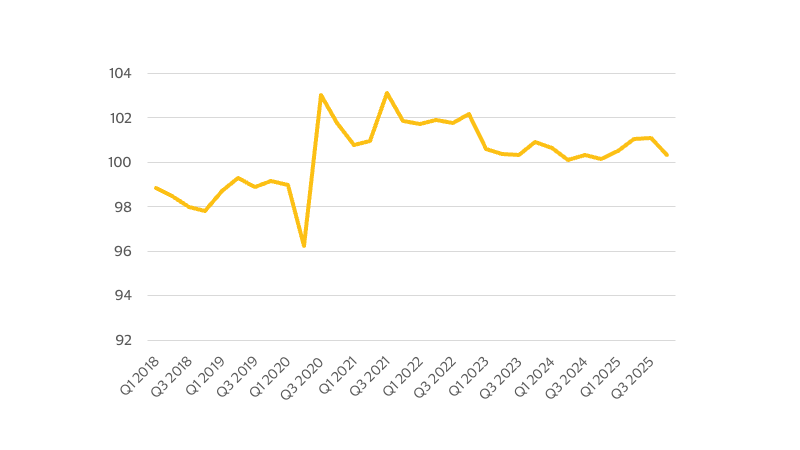
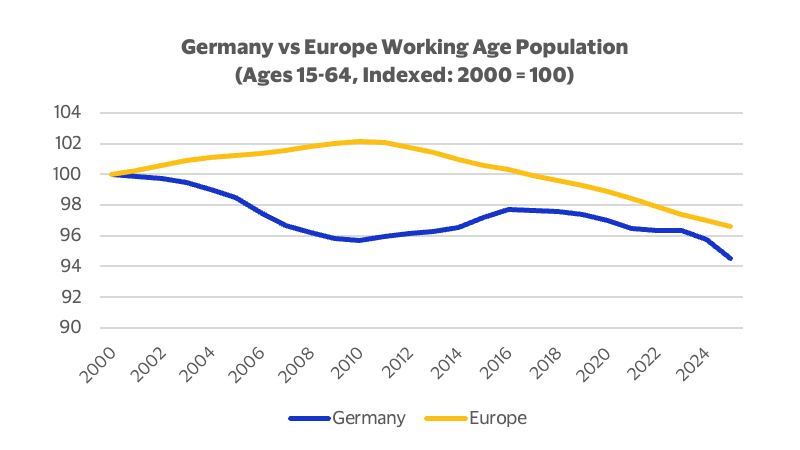
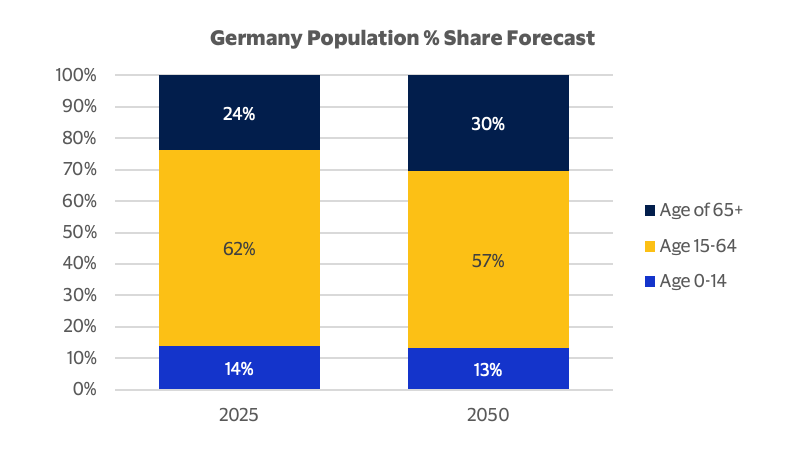
Figure 2: German demographic trends
From imperative to opportunity
As former European Central Bank (ECB) President Mario Draghi put it, “raising productivity is fundamental,” it is the key to unlocking higher living standards when labor supply is stagnating and an antidote to the economic pressures of an aging society. By boosting output per worker, productivity growth can act as a “vital counterweight to demographic changes” allowing economies like those in Europe to continue growing even as the workforce shrinks.⁵
SMEs present a key focus area for improving productivity. In general, this segment of businesses is crucial because they are central for employment and support a large share of total value added, so when they thrive, entire communities and economies do too. Germany’s SME sector (the famed “Mittelstand”) contributes about 56 percent of value added in the country.⁶ Such figures underscore that meaningful economic growth in Germany may hinge on increasing labor productivity in the SME sector.
Improving labor productivity for SMEs in Germany also presents an opportunity. SME productivity in Germany is approximately 39 percent lower than that of large enterprises.⁷ If German SMEs could even partly close this gap the payoff would be sizeable. For example, McKinsey estimates that bringing German SME productivity closer to large-firm levels would be equivalent to adding approximately 2.6 percent of GDP to Germany’s economy.⁸
On the margins
Recent research demonstrates that investments in technology, particularly digital payments technology, can boost labor productivity for SMEs. Specifically, a 10 percent increase in point-of-sale terminals per employee leads to roughly a 0.5 percent rise in labor productivity, meaning workers can handle more transactions or customers without additional labor hours.⁹ In general, digital payments speed up checkout lines, reduce manual cash handling, and enable self-checkout—all of which allow staff to serve more customers in the same amount of time.¹⁰ In other words, labor becomes more efficient because technology supports faster, smoother workflows.
As stated earlier, increasing labor productivity boosts overall economic growth. At the merchant level, it can raise profit margins by lowering the cost per unit of output. This is possible because the connection between labor productivity and profitability flows directly from the cost structure of a business. Each business has fixed costs that stay the same with additional output (rent, salaried labor, management, software systems, etc.) and variable costs that rise as output rises (inventory, shipping, sales commissions, etc.). When productivity increases, a company can generate more revenue using the same cost structure. That means a larger share of revenue drops to the bottom line.
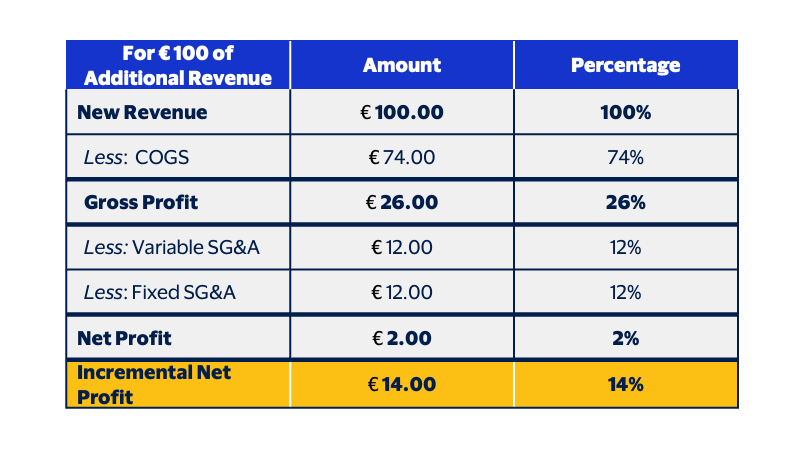
Let’s use an example to illustrate this concept. Consider a German SME with a 26 percent gross margin, a profit margin of 2 precent, and selling, general, and administrative (SG&A) cost structure split 50 percent fixed and 50 percent variable. For every extra €100 of revenue, €74 goes to cost of goods sold (COGS) with €26 remaining as gross profit. Since net profit margin is 2 percent, then €2 of each incremental €100 revenue is net profit. This implies that the remaining SG&A costs are about 24 percent of revenue. Of this amount, 12 percent varies with sales, while the other 12 percent is fixed and does not change with increased revenue. In our example, the variable SG&A costs increase by €12, but the fixed SG&A costs do not increase with the incremental sales. After covering the costs that are scaled with revenue, the company earns €14 of incremental profit. As a result, improvements in labor productivity translate into a 14 percent incremental profit margin for the SME.
Figure 3: SME incremental profit example
The bottom line
Modern payment technologies offer tangible, measurable productivity improvements, translating directly into improved profitability.¹² Even modest productivity gains compound over time, improving individual business outcomes and cumulatively strengthening the economy. For German SMEs, productivity growth is a potential path to sustained prosperity.
The future Mittelstand can be digitally empowered, efficient, and competitive—capable of doing more with limited labor, adapting to evolving customer needs, and thriving amid demographic and economic challenges. This vision requires business to treat payment technology as strategic investments. This imperative could, in turn, be potentially amplified by policymakers that provide the right incentives and supportive frameworks to encourage investment in digital payment technologies. Productivity through payments is not merely a slogan, it is a practical pathway to profitability and long-term sustainable growth for a country like Germany.
Footnotes:
- World Economic Outlook Update, January 2026: Global Economy: Steady amid Divergent Forces
- VEEI analysis of ECB labor productivity data
- Structural Change in Germany: Productivity, Regional Aspects and the Labour Market. National Productivity Report 2025
- VEEI analysis of United Nations World Population Projections (UN WPP) 2024 data; the geographical region of “Europe” is defined in the UN WPP 2024 data by using “Standard Country or Areas Codes for Statistical Use” (UNSD — Methodology) which includes the following countries: Åland Islands, Channel Islands (Guernsey, Jersey), Denmark, Estonia, Finland, Iceland, Ireland, Isle of Man, Latvia, Lithuania, Norway, Sweden, United Kingdom, Austria, Belgium, France, Germany, Liechtenstein, Luxembourg, Monaco, Netherlands, Switzerland, Belarus, Bulgaria, Czechia, Hungary, Poland, Republic of Moldova, Romania, Russian Federation, Slovakia, Ukraine, Albania, Andorra, Bosnia and Herzegovina, Croatia, Greece, Holy See, Italy, Malta, Montenegro, North Macedonia, Portugal, San Marino, Serbia, Slovenia, and Spain.
- Bengtsson, J., Heimes, H., Heuss, R., Marcus, I. (2025, September). To unleash productivity in Europe, rewire your operations. McKinsey & Company.
- The economic contribution of small and medium-sized enterprises remains high despite the current crises - Institut für Mittelstandsforschung Bonn
- McKinsey Global Institute. (2024, May). A microscope on small businesses: data snapshot for Germany.
- McKinsey Global Institute (2024)
- Cormier, M., Diniz, G., Garcia-Swartz, D., Latham, O., and Tzanetaki, C. (2025, October). Digital payments, output, and productivity: an empirical exploration. Social Sciences Research Network.
- Cormier, M., Diniz, G., Garcia-Swartz, D., Latham, O., and Tzanetaki, C. (2024). The Social Value of Innovation in Payments. Social Sciences Research Network.
- VEEI Analysis of EUKLEMS data
- Brodsky, D. (2025, December). Do digital payments increase productivity? Visa Economic Empowerment Institute.
Disclaimer: Case studies, comparisons, statistics, research and recommendations are provided “AS IS” and intended for informational purposes only and should not be relied upon for operational, marketing, legal, technical, tax, financial or other advice. Visa neither makes any warranty or representation as to the completeness or accuracy of the information within this document, nor assumes any liability or responsibility that may result from reliance on such information. The Information contained herein is not intended as investment or legal advice, and readers are encouraged to seek the advice of a competent professional where such advice is required.